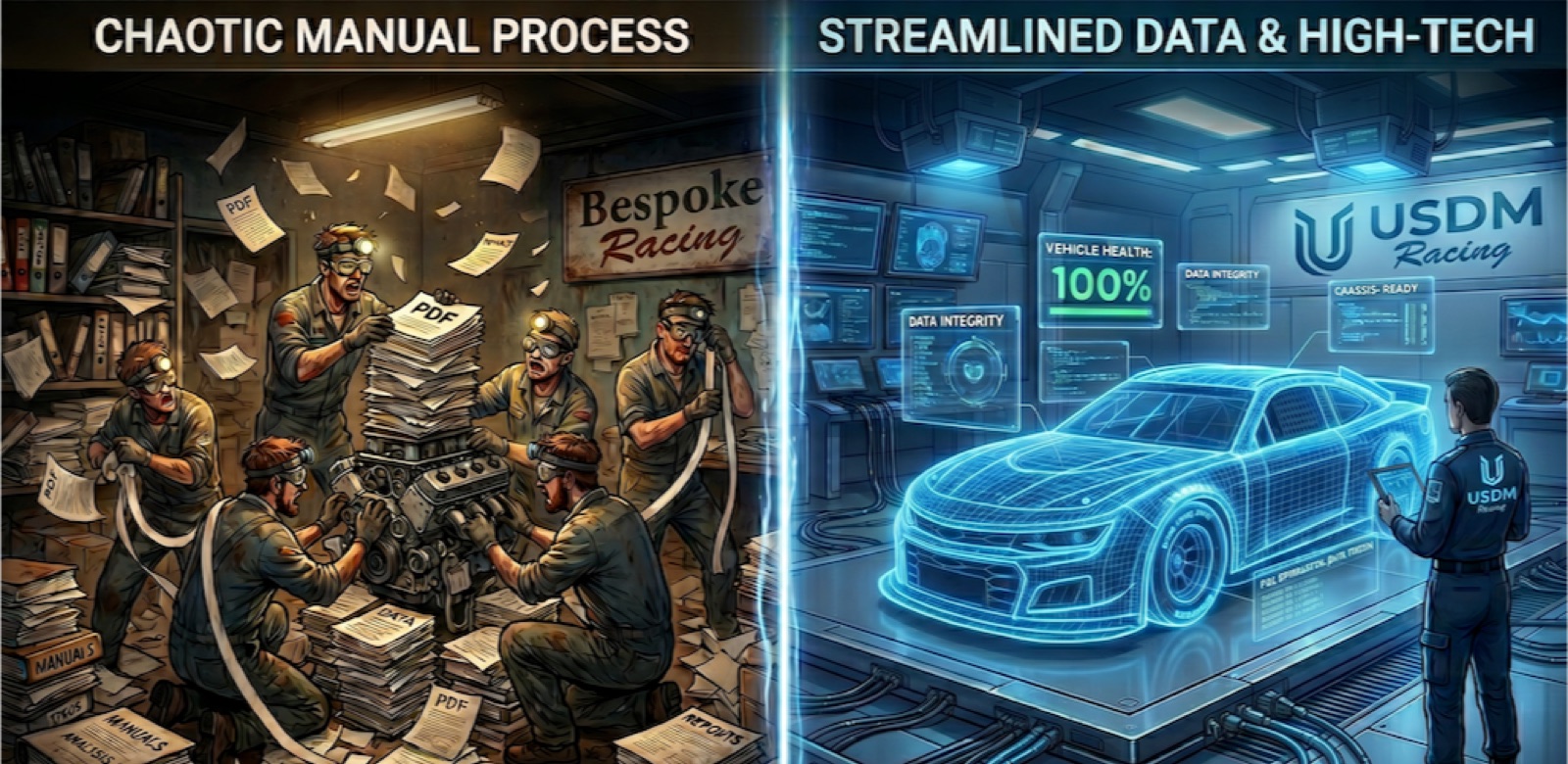
In the previous article I used an analogy to demonstrate that our drug development process resembles F1 economics and argued for a standardized NASCAR like approach. I named five things the “passenger” (patient) deserves and the first was that the passenger deserves a car that has been built before.
The trial they are in should run on a foundation the industry has already agreed on. Parts that fit together by design, not by integration project. A chassis that is the same chassis whether the disease is oncology, cardiology, neurology, or rare disease. The first time a sponsor runs a Phase 3 in their disease area should not be the first time anyone has solved how to move data from the bedside to the database to the submission. The car should exist already. The trial should pick it up and drive.
This article is about what that actually means. It means a foundation where every downstream system can be built on without rebuilding. It means a protocol that the next system can read without a human typing it in. It means a substrate where provenance is native.
In other words, the passenger does not need a custom car. They need a car that has been built already. Someone has already designed the engine, the chassis, the steering, the brakes. Someone has already standardized the parts. The crew can spin up the car because the parts catalog exists. The car is what the catalog produces, not what each crew designs from scratch.
In clinical trials, the parts catalog is the protocol. But the parts catalog is still being assembled by hand for every single trial, at multiple locations, by multiple stakeholders.
Every clinical trial protocol today is a document, a long PDF. A medical writer composes it. A regulatory team reviews it. Then dozens of other people read that document and re-enter what it says into the systems they each use. The EDC team builds case report forms. The data team writes mapping specs. The site team decides which visit goes where on the schedule. Every reader interprets. Every interpretation drifts. Every drift compounds. Yet, operationally, we expect every interpretation to be consistent across every operational team that is running this protocol.
90% of clinical trial protocols are still written this way. That is TransCelerate's own estimate, October 2025.
The patient is paying for that interpretation work in months added to their trial start-up. They do not need new science. They need a foundation that allows the help they need to get to them faster and more efficiently.
This foundation is being poured by a wide set of contributors that I cannot fit into one post. Here, I want to share 5 names. These 5 people are not a coalition. They are not all coordinated. But they are converging.
Bill Illis
Bill Illis runs technology strategy for clinical development and analytics at Novartis. Since 2019 he has also led TransCelerate's Digital Data Flow workstream, which means he is the person who has been arguing inside the top five sponsors for what the protocol should look like as a piece of structured data. I met Bill late 2024 at the Innovation Gathering Network conference. He gave a TED-style talk titled "Shipping Containers and Electrical Outlets." His framing question was the one that opens this piece: How can we go fast AND far to deliver the treatments patients need? His argument is that every industry that has ever scaled has done it by agreeing on a container. SMS messages. Unicode. ISO shipping containers. Electrical outlets. Clinical research has not yet agreed on its container. Bill has spent six years moving the industry toward that agreement.
Dave Iberson-Hurst and Berber Snoeijer
Dave Iberson-Hurst and Berber Snoeijer are the two people most directly building what would actually serve as that container. Dave is a partner at the Danish consultancy d4k. Berber runs ClinLine in the Netherlands. Both hold technical leadership roles at CDISC on contract, not as employees. Dave is the USDM Product Owner. Berber leads the USDM Development Team. In "USDM, Where Do I Start", the newsletter pieces Dave published in April 2026, he reached for an extended construction analogy. The clinical trial house, he argued, sits on bare ground. USDM is what gives it a foundation. Once you have a foundation, everything else can be built on it without being rebuilt. I met Berber in real lif at the 2026 Phuse conference in Austin TX. There, she presented her PHUSE US Connect 2026 paper documents with the technical timeline. USDM version 4 was released in June 2025, the first stable version. ICH M11 was finalized in November 2025. "The industry is now in the stage of adoption of this data model," she writes. The spec is real. The build is shipping.
Katja Glaß
Katja runs her own consultancy from Berlin. She also manages the OpenStudyBuilder community on behalf of Novo Nordisk, and she sits on the board of the CDISC Open Source Alliance. Three seats. One thesis: the substrate is not only code. It is the governance and the licensing that keep code shared across competitive sponsors. Novo Nordisk released OpenStudyBuilder under GPLv3 in 2022. For three years it was a Novo Nordisk project that anyone could read. In 2025, Boehringer Ingelheim contributed code to the repository. That is not just a pull request. It is the moment a sponsor's project becomes a commons. Katja's PHUSE EU Connect 2025 paper walks through what it takes to keep that signal alive: licensing, legal review, contributor agreements, governance. "The code is rarely the diamond," she writes at the close. The diamond is everything else.
Ali Benfattoum
At AWS, I got to know Ali Benfattoum and he sits on the board of the FIWARE Foundation. He is also the creator of the Garnet Framework, an open-source substrate for what he calls a real living digital twin. Ali is not like the others on this list but our 2+ year relationship has put me on a path converging on how multiple standards could be actually glued together in the most elegant way.
The Garnet Framework is worth describing on its own terms. Garnet Framework is built on NGSI-LD (Next Generation Service Interfaces - Linked Data), an open standard that extends both JSON-LD and RDF. It produces a dynamic knowledge graph that captures relationships, time, and space, and it exposes that graph through a REST API that other systems can subscribe to for complex events. The graph is shaped by a core cross-domain ontology, which is the load-bearing piece: the ontology describes the world rather than describing one industry. Whatever domain you point Garnet Framework at, the substrate is the same.
The proof is in what runs on it. The Madrid City Council’s MiNT platform, presented at Smart City Expo World Congress in November 2025, manages five million geolocated municipal assets through an IoT layer called GRIOT, built on AWS Garnet Framework. GrupoTX in Panama runs a commercial platform called AsterIoT, also built on Garnet, deployed at IDAAN to monitor the country’s water systems. IBM Consulting in March 2026 named its smart city solution GICA, which stands for Garnet IoT Context-Aware. Three named production systems. Three continents. Same substrate, instantiated three different ways.
The reason to name Ali in a piece about clinical research is not that Garnet Framework runs clinical trials. It shines a light on the fact that the logic Bill Illis is arguing for is not theoretical. A cross-domain ontology that describes the world, exposed as a knowledge graph through an open API, already exists. It already runs at scale. The question is not whether it can work. The question is what gets built on it next.
The pattern
What is striking about these five people is not what they share. It is what they have not shared.
They are not all coordinated, they are converging, and their convergence shows up four ways:
- They reach for the same metaphors without coordination: shipping containers, foundations, USB cables, electrical outlets.
- Their workstreams meet at USDM without governance overhead
- They hold their leadership seats as independents, not as employees of the sponsors that will use the foundation.
- Adoption is rising on its own: TransCelerate's Solution Collaboration Forum grew from 7 founding members in 2021 to more than 45 in 2025. OpenStudyBuilder went from a Novo Nordisk repo to a Boehringer Ingelheim contribution.
Dave put it cleanly. "We are not building silos, we are building an ecosystem of collaboration."
What becomes possible
If this work continues and connects, the patient gets the first dose months earlier. Their protocol becomes a piece of structured data that travels through every downstream system without anyone re-keying it. The EDC setup is generated from the protocol, not built from a fresh interpretation of it. The mapping to submission format is built in, not bolted on at the end. ICH M11 enforcement starts in June 2026, one month after this post. Sponsors that are ready will move faster. Sponsors that are not will pay the calendar tax. The patient pays either way, but they pay less when the substrate is in place.
The next sponsor that wants to run a trial in the same indication does not have to start from scratch. They can read a previous protocol as data, not as a document. They can fork it, amend it, and run a new study faster. The protocol becomes a library, not a one-time deliverable.
What it takes
For this to materialize, five things need to be true.
- The spec has to be a real spec. USDM version 4 is the first stable release. The next decade depends on whether it stays stable while continuing to grow.
- The reference implementations have to keep shipping. OpenStudyBuilder is one. Garnet Framework can be another. There need to be more, and they need to share the same substrate so that switching between them is cheap.
- The people doing the architecture have to be independent. Dave at d4k, Berber at ClinLine, Katja at her own consultancy. None of them works for a sponsor that has a commercial interest in the substrate's shape. That is what makes the substrate trustable. If the architects worked at any one sponsor, the substrate would tilt toward that sponsor.
- The regulators have to keep moving. ICH M11 enforcement is the next milestone. The FDA and EMA digital modernization efforts have to land the ones after that. Without regulatory pull, sponsors will not invest.
- The money has to outlast any one sponsor's interest. The substrate is a multi-decade commons. Quarterly funding cycles will starve it. The capital model has to look more like a foundation and less like a project budget.
So let’s go back to the passenger (the patient)
They are still on the track. The foundation is being poured. They do not know that and they do not need to know that. They need it to keep being poured.
And they need what's to come in the next article: In Clinical trials, patients deserve a crew that has done this before.
The site coordinator, the principal investigator, the monitor, the medical writer, the data manager all carry expertise that took years to build. They should be spending that expertise on the science, not on learning whichever proprietary stack the current trial happens to use. A NASCAR pit crew gets faster every race because the equipment is the same equipment. The clinical pit crew should get faster every trial for the same reason. Right now it gets slower, because every new sponsor relationship (sometimes just a new trial) is a new set of tools, new workflows, new audit trails, new templates. The crew is athletic, but he current foundation makes them run uphill everyday and twice on Sundays.
About the author
Bo Lora spent four years at AWS deeply embedded across more than thirty roles in the clinical research value chain, from sites to sponsors, CROs, tech vendors, start-ups, and regulators. He held Core Technical Field Community Leadership in Health and Life Sciences. Before that he was a consultant at BearingPoint, working across finance, telecommunications, manufacturing, and semiconductors. He started his career as a BBN Field Engineer in Stuttgart in 1989, where he once flew to Oslo to fix a modem that was unplugged.
He is active in CDISC, Vulcan, and TransCelerate, and serves as AI Faculty for ValueAdd Group.