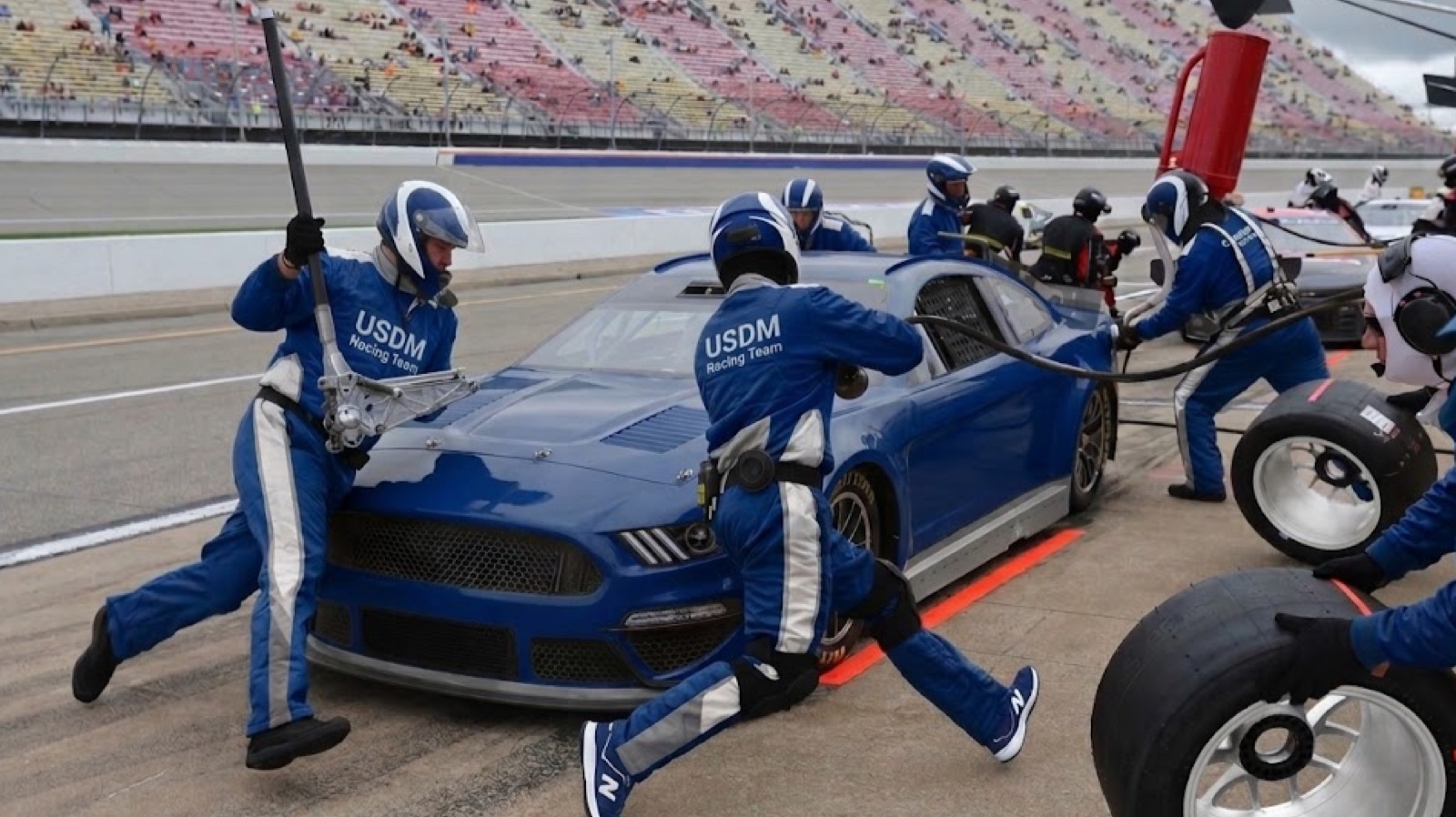
In this series of articles, I began with an analogy around the switchboard era and then pivoted to an analogy around NASCAR and how standardization has dramatically cut costs compared to FI economics.
A car without a crew that has done this before is just an object.
I've had the privilege to be on pit row during a NASCAR race and watching the crews work is its own education. The thing nobody outside the sport tells you is where these athletes come from. NASCAR pit crews are often recruited from college football. These crews going over the wall are athletes. They have spent considerable parts of their lives in fitness regimens of muscle memory, executing at high speed under pressure, on equipment they trust because the equipment does not change.
That last part is something I want to focus on in this article.
A football player reads the opposing line and knows what the play is going to be because the field is the same width, the same length, the same ten yard increments season after season. The pads, the helmet, the cleats, the rules, they are the same. The athlete becomes excellent by rehearsing variations of the same task on standardized equipment.
Same for the pit crew. Same gas can., same wrenches, same jacks, same tires, etc. What differentiates the best teams is not the kit, it is how they jump the wall, how they spray the lubricant, how they have practiced this exact sequence thousand of times.
This is why a pit stop takes under ten seconds.
Now imagine the same crew with a different gas can every race. A new wrench. A new jack. Imagine the football player whose field is a different width every game and whose rules change between snaps. We would not be talking about ten-second pit stops. We would be talking about pit stops that take minutes.
That is what we ask of the crew at a clinical research site. Every trial brings a different protocol. Every sponsor brings their own vendor stack. Every study brings a different eCOA, a different EDC, a different eConsent platform, a different reporting cadence. A different CRA that demands things that may not be grounded in actual regulation. The crew is full of people who would be athletes if we let them. Instead we ask them to relearn the equipment, processes, rules, etc. on EVERY study.
In clinical trials, patients deserve a crew that has done this before. They deserve athletes.
And athletes only exist where the equipment does not change and they can practice constantly before game time.
Edye Edens, CEO of EEDEE Law, named the cost in her Clinical Trials Day piece this year. She did not call it the cost of athleticism denied. She called it a governance problem. Her line: "an investigator can only supervise what they can reasonably understand." When the equipment changes every study, the crew cannot supervise what they cannot rehearse. Accountability becomes diffuse. Fragmentation becomes the risk.
This piece is about the crew. About what operational excellence actually means when you stop measuring it in throughput and start measuring it in muscle memory.
Last week's piece named people working on the foundation. Today is about the people who run it. There are five people I want you to know.
Dan Sfera
Dan Sfera is a site operator, a podcast host, and the founder of DSCS CRO. He runs sites. He coaches sites. He runs Coordinare.co, a free toolset for sites that cannot pay for software. He runs a CRC and CRA academy, which is the unglamorous, one-trainee-at-a-time work of building the practitioner layer. He hosts The Clinical Trials Guru podcast. He is also a co-owner of PatientACE and an investor in Gleam, which matters less than the framework he has built around the operational layer.
His framework is sharpening the vocabulary the site community uses to talk about itself. Agents do the middle of the work. Humans own the ends. The industry is moving from trust-but-verify to verify-then-trust. Tools commoditize. Judgment does not. Dan is teaching the site community how to see itself in the agentic era, and he is training the next generation of CRCs and CRAs while he does it.
Brad Hightower
Brad Hightower has spent fifteen years at the site level. He is the founder of Hightower Clinical and the former executive director of the Oklahoma Heart Hospital Research Foundation. He hosts the Note to File podcast, which is where the actual site-level conversation in this industry happens. CRC realities. Budget realities. The fragmentation of sponsor and CRO requirements. The Latin tagline under his name reads ipse se nihil scire id unum sciat: he himself knows only one thing, that he knows nothing.
That is the conscience seat in operational excellence. The veteran operator who keeps reminding the industry what the work actually looks like at the site, and what it costs the people who do it. Brad is the locker room. He is also the film room. He is amplifying the work of operators across the country one episode at a time.
Kaye Doiron
Kaye Doiron is founder and CEO of both Research Works INC and Samaras Inc. She spent over twenty years running clinical trial research sites before building Samaras to solve the operational problem from the inside.
She calls it Patient Negative One. The simulated patient you run through every visit, every system, every platform login before a real patient ever walks through the door. Process map the trial. Hand the map to the CRO, the sponsor, the site, the solution provider. Watch where the operations break. Fix it. Run it again. She turns it into a chant at recent talks.
Before your study begins, you make sure you have run through Patient Negative One.
This is what athletes call film and walkthrough. This is what NASCAR calls practice. Samaras delivers it as simulation-based, protocol-specific training environments where the crew demonstrates proficiency before a trial activates. Trial-ready teams before day one. This is the rehearsal layer the dimension has been missing.
Dr. Daniel Fox
Dr. Daniel Fox runs the Clinical Research Payment Network. He has nearly twenty years across academia, biotech, pharma, and site administration and the operator behind Land of Lincoln Clinical Research.
CRPN exists because the payment cycle is a chronic operational failure no amount of tooling fixes. A crew cannot deliver operational excellence if sites cannot make payroll. Daniel is the financial advocate. He is teaching sites how to fight for fair budgets, how to read contracts, and how to refuse to overcommit. He is also the bridge between site economic reality and the rest of the industry's standardization conversation. Standardized work needs standardized terms. Daniel is making the contracts case.
Lindsey Wahlstrom
Lindsey Wahlstrom is the co-founder and Chief Momatologist of Rona's FUN LAB. The lab is named for her daughter Rona, who got a one-in-a-million diagnosis at age five and died from complications of her treatment two weeks after her sixth birthday. Lindsey lived clinical research from two sides at once: as a professional in the field, and as a mother whose only treatment option for her daughter was experimental.
Rona's FUN LAB exists to protect quality of life for critically ill children by embedding emotional safety, understanding, and dignity into pediatric care. The organization matches pediatric care teams with the resources they need, it trains care teams, and it works with hospitals, child life specialists, and providers to lighten the burden families carry during serious illness. For pediatric rare disease patients, the research team and the care team are often the same crew. There is no other treatment plan. Lindsey is teaching the crew how to be ready.
(Disclosure: I am a board advisor at Rona's FUN LAB.)
The pattern
These five are not a coalition. They are not coordinating. They are not employees of the same organization.
But they are converging.
Each one has built their own platform to speak from. An academy, podcasts, site-level community (Save Our Sites), a venture-backed simulation training platform, a payment network, and an organization to address critically ill children. They are all operator-aligned, not sponsor or CRO or vendor. They are all teaching as part of the work, which means the crew is being built one practitioner at a time. They are all saying the same thing from different angles. Operational excellence is a function of human judgment. The tools amplify it, they do not replace it.
What becomes possible
The patient gets a crew that actually knows what they are doing. The visit runs on time, the consent is meaningful, the data is captured cleanly, the query is closed before the monitor flags it., the screen failure rate is honest because the site knows its own numbers. The retention to primary endpoint is real because the crew has done this study, or one like it, before.
The site negotiates from data, not from adjectives. The trial hits enrollment because the crew can run it, not because the sponsor padded the projections. The investigator can actually supervise the work, because the operational layer is governable.
The child with a rare disease gets a crew on her case the day she arrives, not a stranger relearning the equipment.
What it takes
Five things have to be true for this to compound.
Data ownership at the site layer. Sites generate one hundred percent of study data and own almost none of it. Until the crew can see its own performance across studies, indications, and years, it cannot rehearse. The substrate piece named the technical answer. This piece names the practical demand. The site that owns its data is the site that can prove the crew is real.
Training that survives staff turnover. Dan's CRC and CRA academy is one move. Kaye Doiron's simulation-based protocol training is another. Lindsey's care team work is a third. There need to be more. The crew compounds across years, not quarters. Quarterly staff turnover starves the foundation. The industry needs a training layer worthy of the work it is asking sites to do.
Payment cycles that respect the work. Daniel Fox's argument. Sites cannot run operational excellence on a hundred and eighty day payment cycle. The contract is the equipment in the financial sense. If it changes every study, the crew cannot stabilize. If it is fair and predictable, the crew can plan.
Vendor discipline at the sponsor and CRO layer. Every additional vendor stack on a trial is another piece of equipment the crew has to learn from scratch. The industry has to stop confusing optionality at the sponsor layer for innovation. Standardization at the operational layer is the gift. The gas can does not change between races.
Governance clarity. Edye Edens's argument. Operational fragmentation has to be treated as a governance question, not an efficiency one. The investigator can only supervise what they can reasonably understand. When the operational layer is opaque to the people supervising it, accountability becomes diffuse, even when every actor is acting in good faith. The crew deserves to be governable. The patient deserves a crew that can be supervised.
The passenger (the patient)
The patient is still on the track. The foundation is being poured. The car has been built before. The crew is coming together one practitioner at a time.
The next question is the track. Does it know them when they arrive? Is the regulator on the same page as the sponsor? Does the path the crew runs down lead anywhere predictable?
That is the next piece.
About the author
Bo Lora spent four years at AWS deeply embedded across more than thirty roles in the clinical research value chain, from sites to sponsors, CROs, tech vendors, start-ups, and regulators. He held Core Technical Field Community Leadership in Health and Life Sciences. Before that he was a consultant at BearingPoint, working across finance, telecommunications, manufacturing, and semiconductors. He started his career as a BBN Field Engineer in Stuttgart in 1989, where he once flew to Oslo to fix a modem that was unplugged.
He is active in CDISC, Vulcan, and TransCelerate, and serves as AI Faculty for ValueAdd Group.