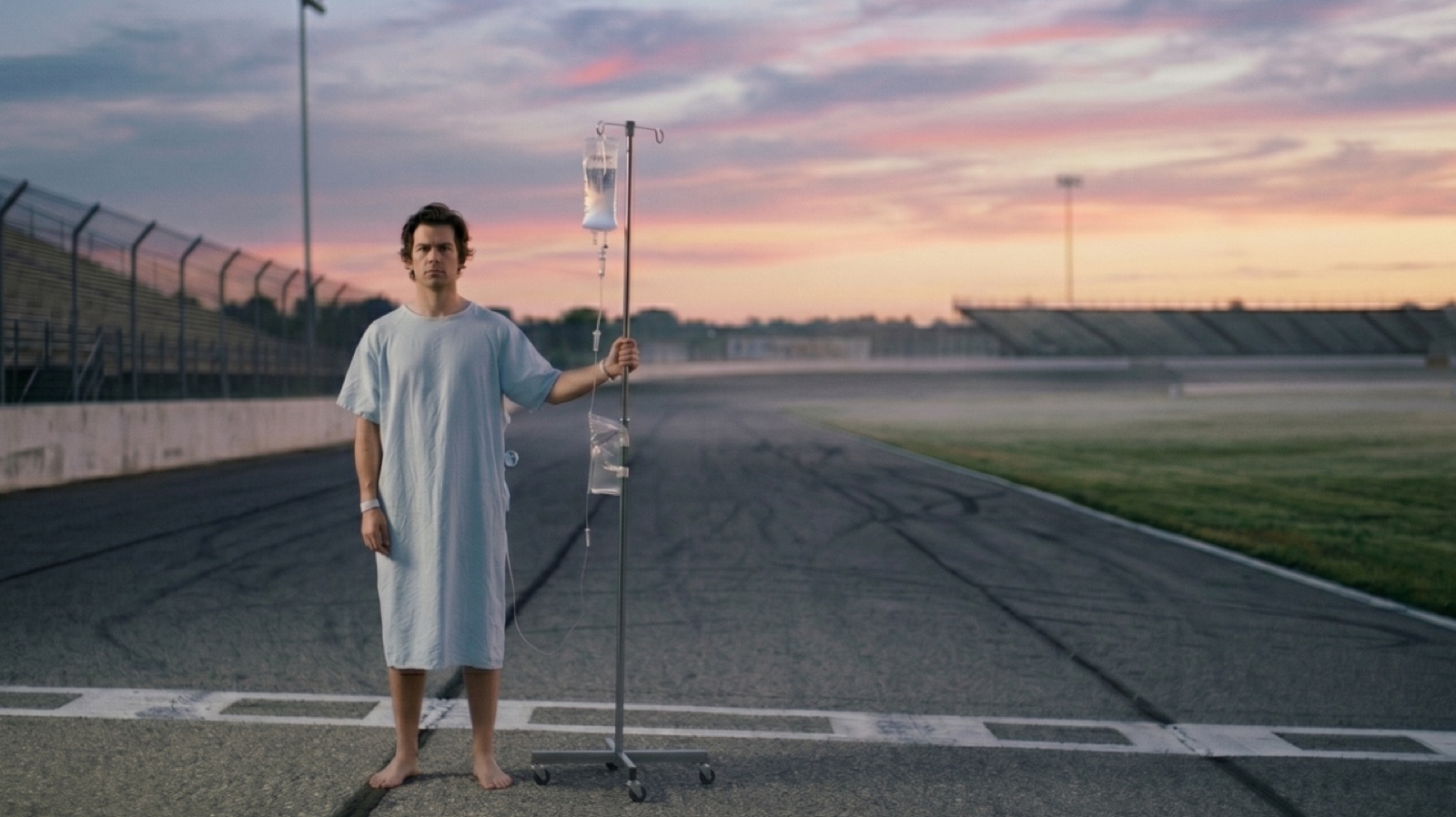
They did not volunteer to race. They did not train. They did not choose the car. They were assigned to it by a lottery. They don't even get to drive. The race is for their life.
That race is a clinical trial.
In my last article, I talked about how clinical trials are still in the switchboard era. Human operators do the routing work the technology should be doing, and the people who sign their names carry attestation liability that no AI in the loop can bear. The architecture is the problem.
That piece named the failure mode. This one names the political economy that keeps it in place. Why hasn't anyone fixed it? Who has the incentive, and who has the authority? There will be more to follow on what the alternative actually looks like in practice.
The FI model
Each F1 team designs and builds its own chassis from scratch. The engineering competition is the sport. Tires come from a single supplier, the ECU is standardized, and a handful of other components are common, but the chassis, the aero package, the suspension geometry, and the power unit integration are bespoke per team. The team that designs the better car wins more races. The team that designs the worse car loses, and over time, fades.
That model worked, financially, for about fifty years. Then it stopped.
Before the cost cap, top teams like Mercedes and Ferrari were investing over $400 million annually, while smaller teams like Force India or Sauber operated on budgets under $150 million, and the on-track performance gap was a direct function of that spending differential. The sport had become a wealth contest with a thin layer of athletic performance on top.
The FIA introduced financial regulations in 2021 as an emergency intervention. The cap was set at $145 million in 2021, reduced to $140 million in 2022, and held at $135 million from 2023 through 2025 with inflation adjustments. For 2026 it was raised to $215 million to absorb new costs being pulled inside the perimeter. A separate power unit cost cap was introduced in 2023 and raised to $130 million for 2026. New manufacturers had to be granted a three-year spending allowance of $148.5 million preceding entry just to make the barrier crossable.
The cost cap is not a cure. It is a stabilization measure.
An Autosport analysis earlier this year argued that under the F1 cost cap, regulatory mistakes now carry compound interest. The team that interprets the technical regulations incorrectly faces corrective spending that competes directly with performance development, which means the competitive gap widens before it closes. In previous cycles, competitive correction could occur through scale of spend. In 2026, architecture risk, regulatory interpretation, and financial constraint converge with a materially narrower margin for recalibration.
Mistakes that carry compound interest.
The integration gravity tax in clinical trials works exactly this way. Every non-interoperable middleware decision, every proprietary integration, every vendor-specific data schema is a tax that compounds with N. The sponsor that gets the architecture wrong cannot recover by spending more, because attention, time, and the regulatory submission window are bounded. The cost was already incurred. The race goes on.
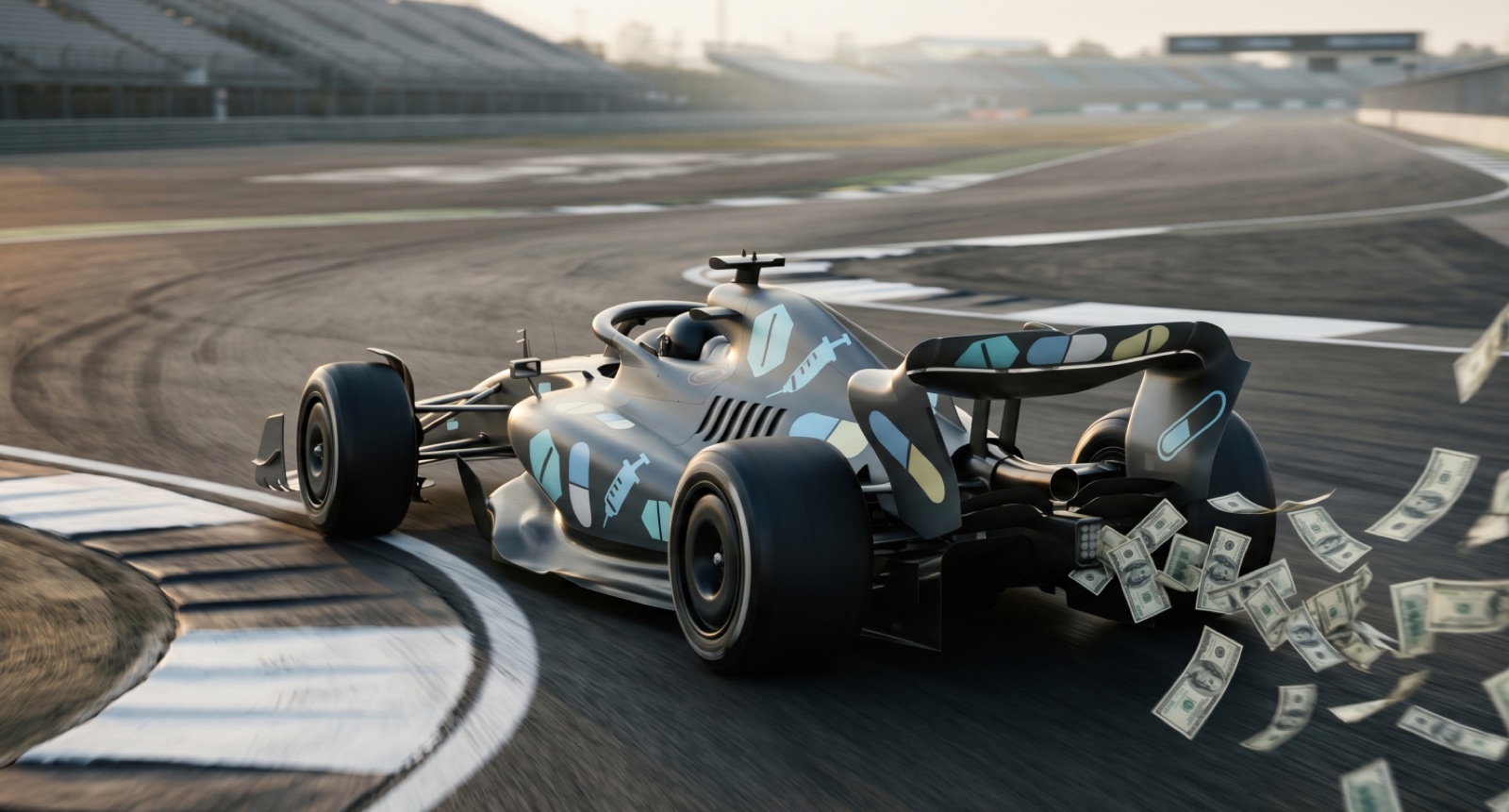
This is the F1 model. High spend on infrastructure competition. Diminishing returns at the surface. A regulator forced into emergency intervention to keep the field viable. And a pathology where mistakes can no longer be corrected by money alone.
This is also what pharma does.
Now let's talk about NASCAR.
Most people think NASCAR is a different sport from F1. It is, but not for the reason they think.
The name "stock car" is the rhetorical relic. The cars are not stock. They look like Mustangs and Camrys and Camaros from a distance, but a 2026 NASCAR Cup car shares no parts with its showroom counterpart. The wheels, the suspension, the gearbox, the chassis are all purpose-built for racing.
What is true is that the cars are effectively standardized across teams. Every Cup car runs on a chassis from a single-source supplier. The transmission is the same Xtrac sequential five-speed. The wheels are the same single-lug 18-inch units. The tires are the same Goodyear spec. The shock absorbers are the same Öhlins units. The body templates are tightly regulated to allow only minor manufacturer-specific aero variation.
The engines are spec-constrained. Each manufacturer, Chevrolet, Ford, Toyota, builds their own V8, but to a common rulebook: 358 cubic inches displacement, 12-to-1 compression ratio, naturally aspirated, with a horsepower target NASCAR sets and adjusts. The current target is 670 hp on most tracks, 510 hp at super speedways, and 750 hp on short tracks and road courses for 2026. NASCAR adjusts these mid-season if any one manufacturer gains an edge. The rule book enforces parity dynamically.
Enforcement is severe. NASCAR's penalty system has a tier reserved exclusively for tampering with single-source vendor parts. An L3 violation costs owner and driver points, playoff eligibility, crew suspensions, and postseason bans. The sanctioning body protects the standardization with the heaviest weapons in the book.
This was a deliberate decision. The Next Gen platform was designed to lower costs and attract new manufacturers to the sport. The horsepower bump for 2026 was decided through collaborative governance with Toyota, Ford, Chevrolet, engine builders, and race teams. Standardization is the explicit policy goal.
So what does NASCAR this cost?
A NASCAR Cup team in 2026 runs anywhere from $3.2 million for a mid-pack one-car operation to roughly $15 million per car for elite organizations like Hendrick Motorsports or Joe Gibbs Racing. A successful single-car Cup operation falls somewhere in the $15 to $25 million per season range.
F1 cost cap for 2026: $215 million for team operations, plus $130 million for power unit development, plus driver salaries and three exempt staff and marketing all outside the cap.
NASCAR top team: roughly $25 million.
F1 cap: roughly $345 million, before exclusions.
The ratio is roughly ten to one.
At the end of the race, both sports produce the same product. World-class drivers operating at the limits of human performance. World-class crews executing under pressure. Real-time decisions made under championship consequences. The drivers in F1 are extraordinary. So are the drivers in NASCAR. I am not going to litigate which set is better, and you would not believe me if I did.
The ten-times-cost premium is not paying for better human performance. It is paying for engineering competition the audience cannot see and the result does not require. F1 spends $200 million per team to differentiate at the chassis and power unit level. NASCAR spends nothing at that level because the substrate is standardized. All spending flows to the surface, where the sport actually happens: driver, crew, strategy, race-day execution.
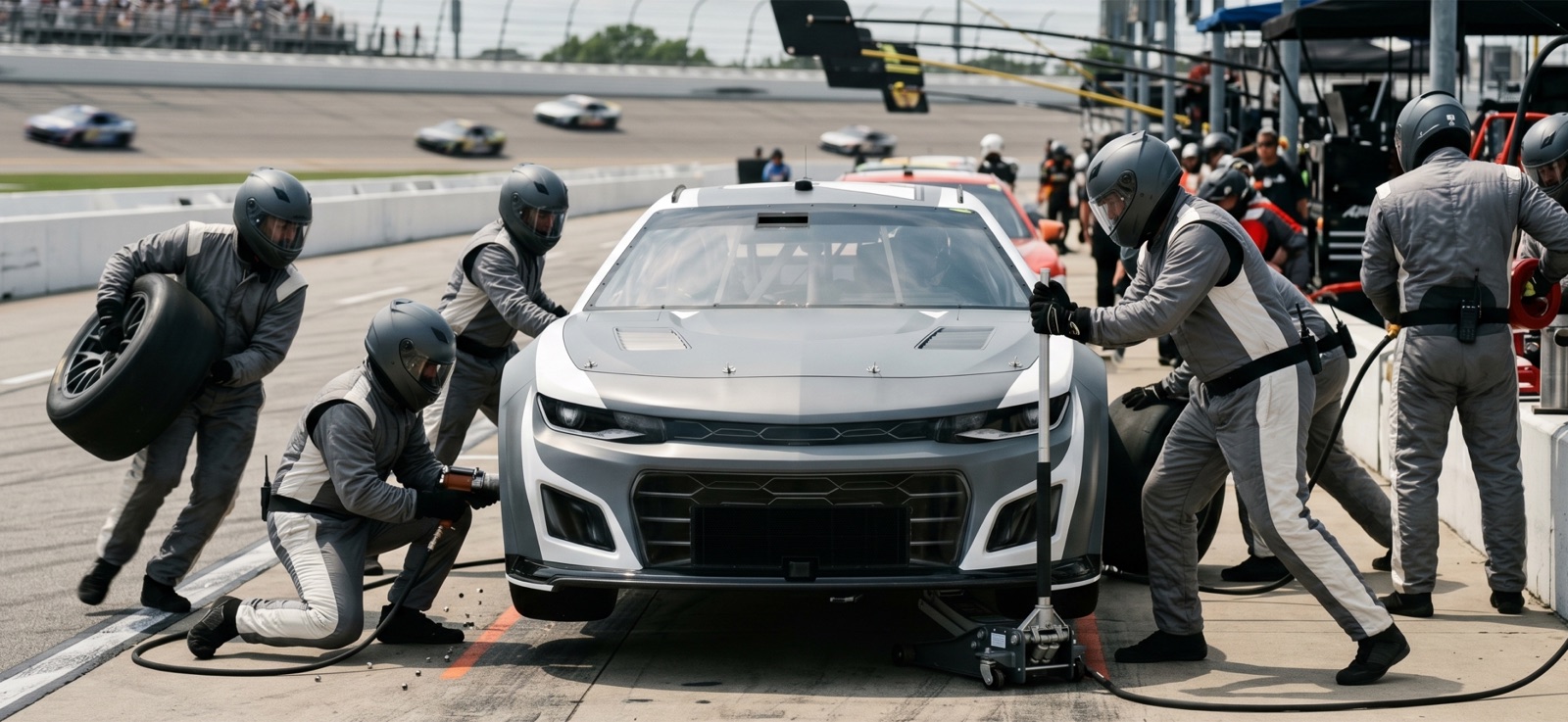
This is the NASCAR model: Bounded spend on a shared substrate. Competition relocated to where the human excellence actually lives. A sanctioning body that protects standardization with enforcement teeth. And a deliberate policy of lowering barriers so new manufacturers can enter and compete.
This is what pharma is NOT doing.
Now back to the starting line.
The passenger is still there. They did not volunteer. They did not train. They did not choose the car. They are in a car that costs ten times what it needs to cost to produce the human excellence they need at the finish line. The premium is not buying them a better doctor. It is not buying them a better protocol. It is not buying them a faster trial. It is buying engineering competition that the disease does not care about and the regulator does not require.
Not all of the unfairness in this race is fixable. The disease is not negotiable. The randomization is not negotiable. The biology of the trial population, the toxicity profile of the molecule, the statistical power required for regulatory approval. Those are the conditions of the race. They cannot be made fair by architecture.
The unfair part is the architecture itself. The car the passenger is in is bespoke, expensive, and slow to ship because the industry has spent decades building proprietary foundations instead of a commons. Every month the cracked foundation eats is a month off the clock for the person in the back seat.
What do patients deserve?
They deserve a car that has been built before.
The trial they are in should run on a foundation the industry has already agreed on. Parts that fit together by design, not by integration project. A chassis that is the same chassis whether the disease is oncology, cardiology, neurology, or rare disease. The first time a sponsor runs a Phase 3 in their disease area should not be the first time anyone has solved how to move data from the bedside to the database to the submission. The car should exist already. The trial should pick it up and drive.
They deserve a crew that has done this before.
The site coordinator, the principal investigator, the monitor, the medical writer, the data manager all carry expertise that took years to build. They should be spending that expertise on the science, not on learning whichever proprietary stack the current trial happens to use. A NASCAR pit crew gets faster every race because the equipment is the same equipment. The clinical pit crew should get faster every trial for the same reason. Right now it gets slower, because every new sponsor relationship (sometimes just a new trial) is a new set of tools, new workflows, new audit trails, new templates. The crew is athletic, but he current foundation makes them run uphill everyday and twice on Sundays.
They deserve a track they have raced on before.
The regulatory pathway should be predictable. The sponsor submitting an NDA should know what the dialogue with the agency is going to look like before it begins, not learn it in real time on the patient's clock. Trial design should draw from precedent, not invent the conversation each time.
They deserve a finish line that is closer.
The integration gravity tax shows up in calendar time. Months of trial delay translate into drugs that reach patients in 2029 instead of 2027. Those are not abstractions. The passenger pays the tax in months of their life. The cracked foundation has been eating the calendar for decades. It does not have to.
They deserve a race where the money flows to the science.
Sponsor spending should go to protocol design, recruitment quality, clinical insight, regulatory strategy. The things that determine whether the drug works. Right now a meaningful share of every trial budget is spent on middleware, integration, and the cost of re-platforming when one vendor of the moment changes its pricing or its data model. The disease does not care which vendor wins. The patient does not care which vendor wins. The science does not care which vendor wins. NASCAR did not lose innovation when it standardized the chassis. It moved innovation to where the innovation matters. Clinical trials would not lose science by standardizing the foundation. They would free the science to be the differentiator.
That is what they deserve.
What none of this answers is what the car actually is. What goes into it. Who builds it. Who gets to drive. Who has the authority to call the race fair and the experience to call the rules. We will explore this in the following articles so stay tuned.
A side note: I am very proud of the fact that my son Tristan Lora is a NASCAR Director of Operations and built the Chicago Street Race for 3 years and this year is bringing NASCAR Street Race to San Diego in 2026.
About the author
Bo Lora spent four years at AWS deeply embedded across more than thirty roles in the clinical research value chain, from sites to sponsors, CROs, tech vendors, start-ups, and regulators. He held Core Technical Field Community Leadership in Health and Life Sciences. Before that he was a consultant at BearingPoint, working across finance, telecommunications, manufacturing, and semiconductors. He started his career as a BBN Field Engineer in Stuttgart in 1989, where he once flew to Oslo to fix a modem that was unplugged.
He is active in CDISC, Vulcan, and TransCelerate, and serves as AI Faculty for ValueAdd Group.