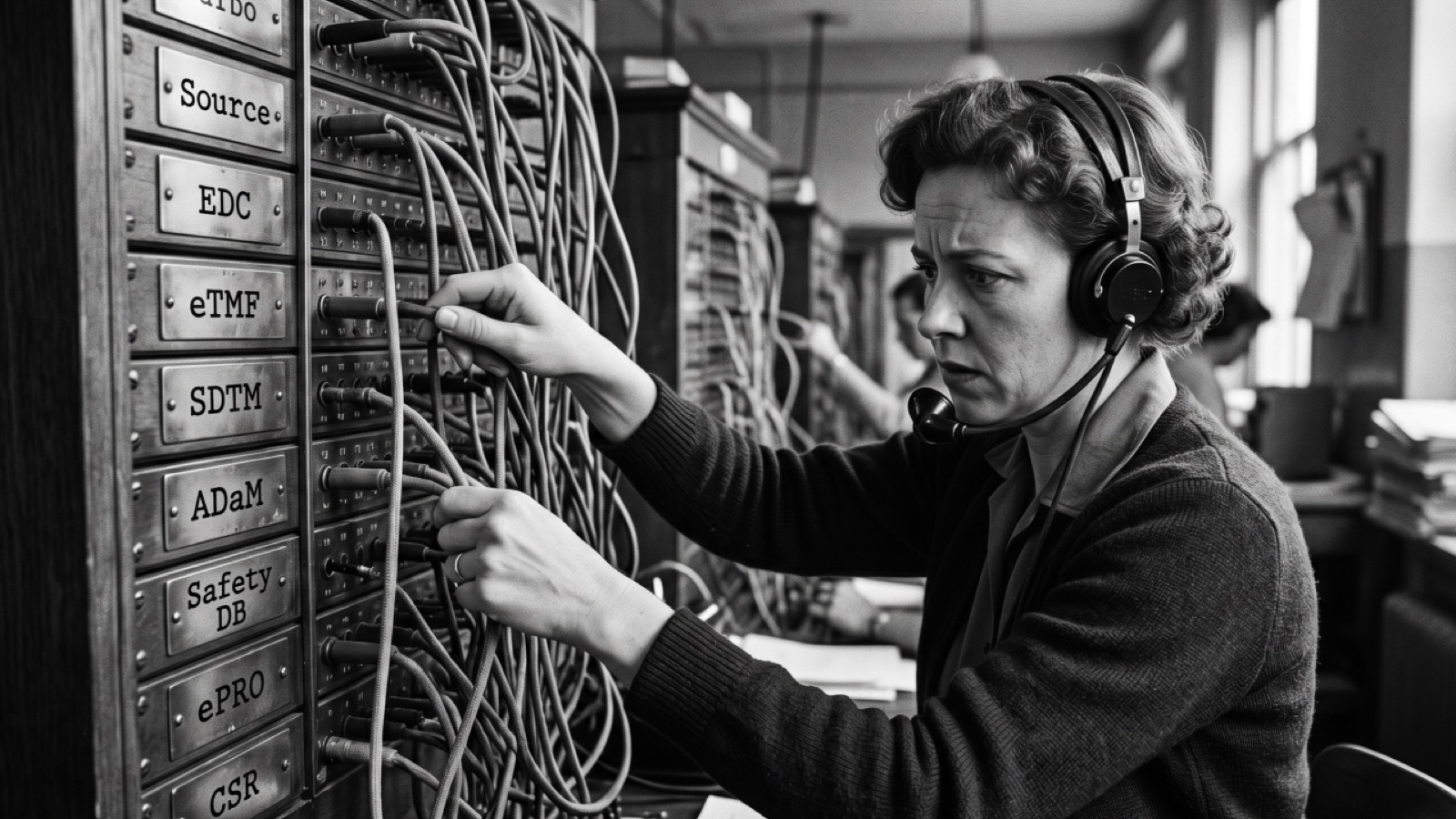
By 1920, AT&T was the largest U.S. employer of women. By the early 1920s, it was the largest U.S. employer overall, with telephone operators comprising around half of its workforce. About 4% of young, white, American-born working women were operators at any given moment, and because turnover was high, roughly 14% of women born near the turn of the century worked as an operator at some point in their lives. The peak in the telephone industry came in 1930, at about 180,000 operators.
The arithmetic was already untenable. Every additional subscriber created connections to every existing subscriber. In large cities, the number of users implied billions of potential connections. Operator labor grew one operator at a time. Connection demand multiplied with every subscriber added. AT&T's own engineers, writing in 1917, described their switchboards as system bottlenecks where service quality was falling and the marginal cost of every new subscriber was exploding. Manual switching could not keep up with network growth. It never would have.
The first crack in that architecture had already come, decades earlier, from an undertaker. In 1891, a Kansas City man named Almon Strowger believed that the local operator was routing his business calls to a competing funeral home. He had no way to prove it. He had no way to audit the connection. So he invented the dial switch, patented it, and removed the human element.
The lesson is older than the telephone industry. When a relay layer can't be trusted, or can't scale, it has to be replaced. Strowger didn't automate because automation was elegant. He automated because the manual layer was un-auditable. AT&T didn't automate because automation was cheap. They automated because the architecture was breaking under its own weight.
Clinical research is communication
A clinical trial is one long act of communication. A sponsor has a hypothesis: this molecule, at this dose, in this population, will produce this outcome. The work of the trial is to communicate evidence supporting or refuting that hypothesis to a regulator, eventually in the form of a submission the FDA reviews. Everything in between is transmission.
The transmission has many hops. A patient walks into a site, a coordinator records what happened. That record is entered into an EDC (Electronic Data Capture) system. Data managers query inconsistencies. Programmers translate clinical concepts into the SDTM (Study Data Tabulation Model). Analysts derive analysis-ready datasets. Statisticians produce tables, figures, and listings. Medical writers compose the CSR (Clinical Study Report). Regulatory professionals assemble the submission. The FDA receives it and reviews it.
At every hop, humans are doing the patching. CRAs reconcile what the site recorded against what the EDC captured. Data managers chase missing values. Programmers translate between standards. Medical writers interpret numbers into narrative. Regulatory professionals reformat everything for submission. At every hop, a human reaches in, picks up the data, and patches it to the next system.
The architecture is the same one we just walked through. A relay layer of humans bridging systems that weren't designed to talk to each other. Different decade, different industry, same shape.
And the same arithmetic. If you have N systems in your study, the possible integrations between them grow as N(N-1)/2. Each one requires a human to design, build, and maintain. Each one is brittle. Each one breaks. Each one needs an operator at the panel.
The thesis Strowger demonstrated in 1891 still holds. A relay layer that can't be audited and can't scale has to be replaced. Clinical research has both problems, simultaneously, today.
Don't put a robot in the chair!
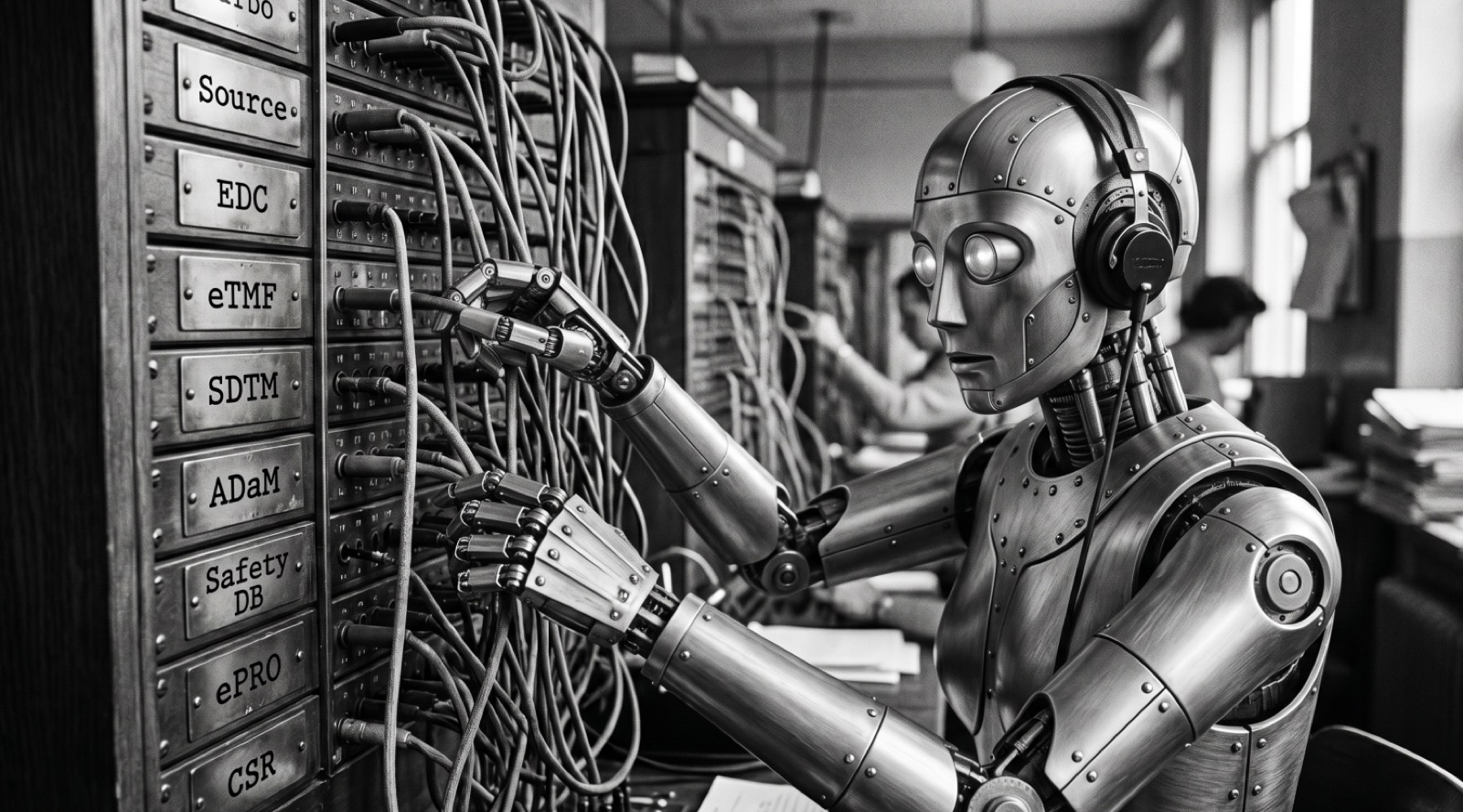
If you've read this far, you might be tempted to say: fine, let's just put a robot in the chair.
The industry is already doing this. AI-powered data management. AI-assisted medical writing. Agentic monitoring. Intelligent reconciliation. Every vendor at every conference is selling a robot (agentic ai) that will sit at the panel and patch the wires faster than a human can.
Last year I wrote a piece earlier called "No, we don't need AI agents to do our shitty work!" The title was the argument. We do not need an AI agent to do what should not be done in the first place. We need to stop doing it. Automating broken work does not fix it. It just makes the broken work faster, and harder to see.
There is a recognizable pattern in how the industry is dressing this up. The same word salad shows up every time. Reliable AI. Trust layer. Explainability. Human-in-the-loop. These words are being used to make automated patching look like architecture. It is not architecture. It is the same operator's chair with a different occupant.
Look at the photograph again. The robot has hands. The robot has a headset. The robot has a posture of focus. The labels on the panel have not changed. There is also a human in the background, still working. The robot did not replace the relay layer. It joined the relay layer.
This is not what Strowger did. Strowger did not invent a robot to sit at the operator's panel. He invented a system in which the panel was not needed for that connection. The dial sent a pulse to a mechanical selector, and the selector did not require a human or a humanoid to interpret it. The work was not automated. The work was eliminated, because the architecture made it unnecessary.
When a relay layer can't be trusted, or can't scale, it has to be replaced.
That distinction is the whole game. Automating a relay layer does not solve the relay problem. Restructuring the system so the relay is not needed solves the relay problem.
It is worth being honest about what restructuring cost. By 1940, telephone operation as an entry-level job for young women had been cut by more than half. Many incumbent operators lost careers they had spent years building. The economic research on this period shows clearly that the costs were real, and were concentrated on the people whose work was eliminated.
It was also right. The same restructuring that displaced operators made the modern telephone network possible, then the modern internet, then everything that runs on it. Humanity did not gain a robot operator. Humanity gained a planet that could communicate at the speed of light, on infrastructure that does not require a human at every junction. The trade was real, the loss was real, and the gain was a civilization.
Clinical research is sitting at the same fork. The robot in the chair is the wrong answer. The architecture without the chair is the right one.
Two worlds, one affidavit
There are two stories the industry tells about its data. There is the one in the dashboard: real-time, intelligent, AI-powered, ready for regulatory submission. And there is the one that gets signed for: reconciled by hand, queried in spreadsheets, traced backward through someone's notes when the audit comes.
The first story is what the executive presents at the board meeting. The second story is what the CRA, the data manager, the medical writer, and the regulatory professional know.
When the submission goes to FDA, only the second story is real. The investigator signs a Form FDA 1572. The statistician signs the Statistical Analysis Plan. The sponsor signs the application. Every signature is a person taking personal legal responsibility for work that, at this point, was largely mediated by systems they cannot fully audit.
AI is not bound by perjury. The human in the loop still is.
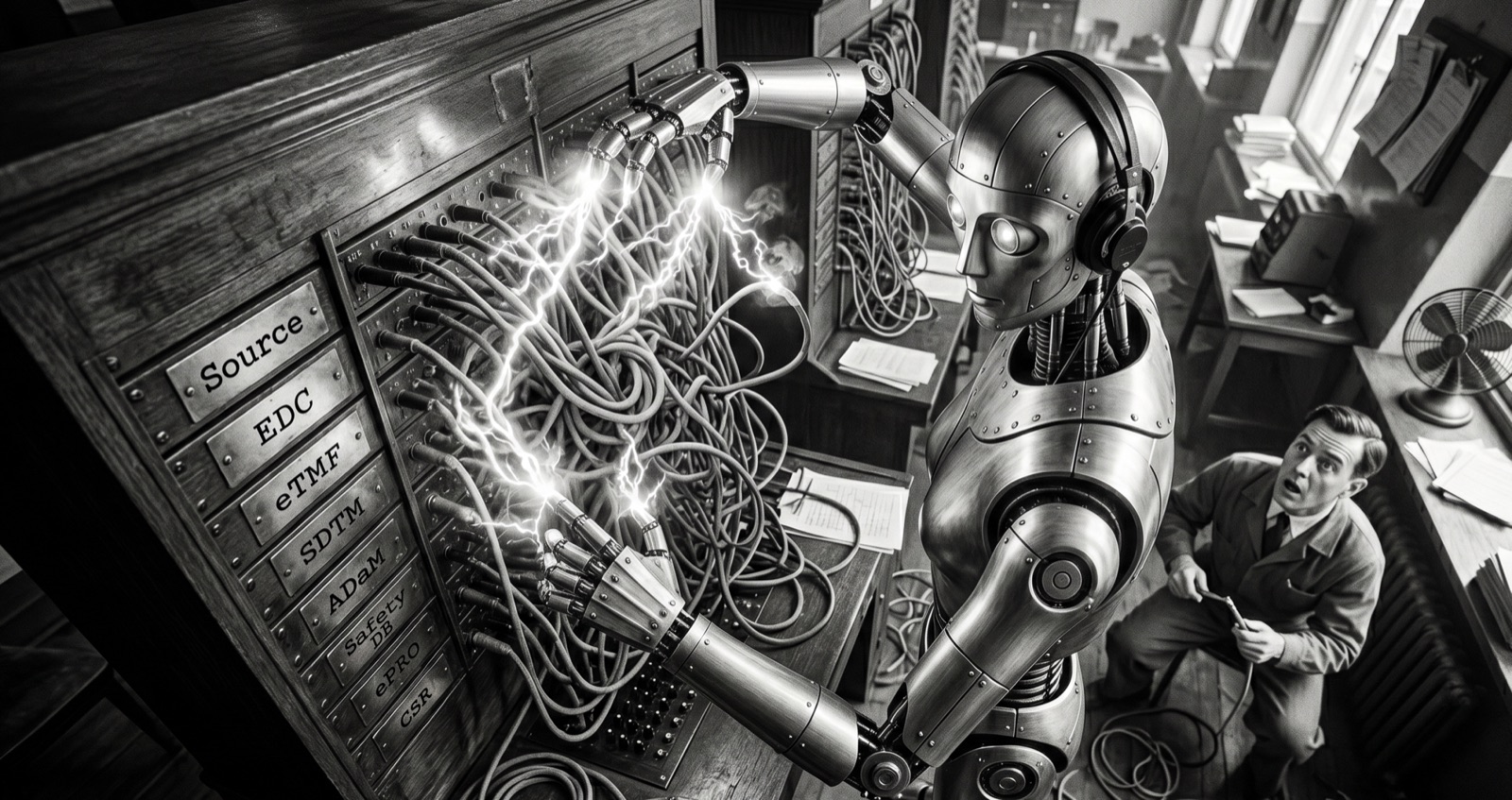
This is what makes clinical research different from the telephone case. When Strowger automated the switchboard, no operator went to jail for a misrouted call. When clinical research automates without restructuring, every person in the chain remains personally accountable for outputs they had no way to verify end-to-end. The work has been pushed into systems. The signature has not.
A relay layer the signer cannot audit is not a relay layer. It is a liability layer.
The foundation has to be built
Strowger gave the telephone industry a foundation. Not a faster operator. Not an automated switchboard. A different layer underneath, where connections happened without the relay.
Clinical research needs the same kind of foundation. The substrate has to record what happened at the moment it happened, not reconstruct it at the moment of submission. Provenance is not an audit feature added later. It is the layer the data should have been sitting on from the beginning.
This is the move that has not yet been made. The eClinical stack added apps. AI vendors are adding agents. Both of them are sitting at the same panel, patching the same wires. Neither of them built the layer that would make patching unnecessary.
And it cannot be built proprietary. The industry has already paid for that mistake at the layer above. Every sponsor has watched a vendor's lock-in tax compound across decades. The next layer has to be a commons.
That work is underway. In the next piece in this series I will tell you who is building it and what they have named it.

The end of the era
The switchboard era of telephone communication ended in stages. Strowger filed his patent in 1891. The first major cutovers came in the 1920s. By the time my grandmother dialed a number in the Dominican Republic in the 1960s, the operator was already disappearing from most of the line. By the time identity-based calling arrived, even the number was gone. Each step was a step out of the era. None of them put a robot in the operator's chair.
Clinical research has not yet taken its first step.
The eClinical stack we have today is not the dial. It is the switchboard with a better UI. The AI agents being sold this year are not the dial either. They are robot operators at the same panel. The era will end when the panel is no longer there, because the architecture underneath does the work the operator was doing.
That architecture has to be built. It has to be open. It has to record what happened at the moment it happened, not reconstruct it later when someone signs for it. And it will end the relay layer the same way dial switching ended the relay layer in 1920: not by automating the operator, but by removing the need for the chair.
Until then, we are still in the switchboard era.
About the author
Bo Lora spent four years at AWS deeply embedded across more than thirty roles in the clinical research value chain, from sites to sponsors, CROs, tech vendors, start-ups, and regulators. He held Core Technical Field Community Leadership in Health and Life Sciences. Before that he was a consultant at BearingPoint, working across finance, telecommunications, manufacturing, and semiconductors. He started his career as a BBN Field Engineer in Stuttgart in 1989, where he once flew to Oslo to fix a modem that was unplugged.
He is active in CDISC, Vulcan, and TransCelerate, and serves as AI Faculty for ValueAdd Group.